How to Practice With a Metronome Without Chasing It
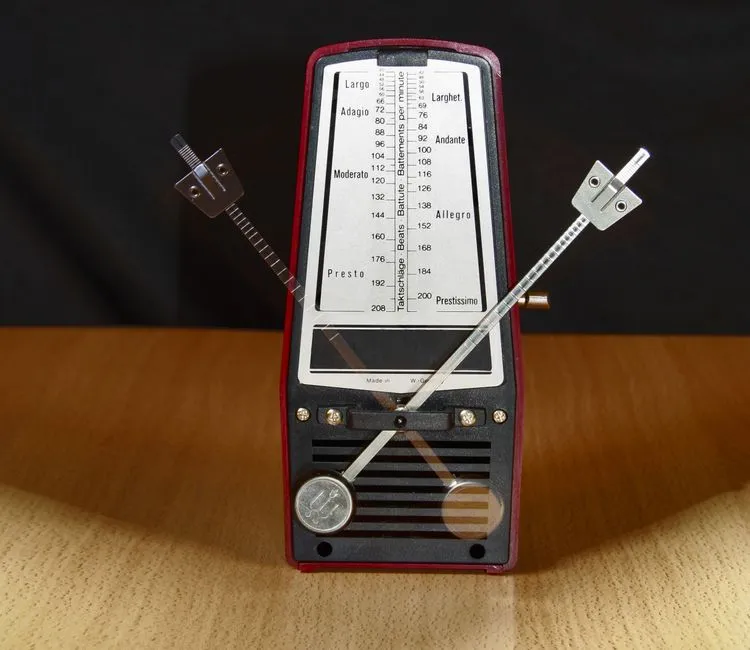
- How should you start practicing with a metronome?
- What does the BPM number actually mean?
- How do you enter on the beat instead of following it?
- How do you count notes between clicks?
- What should you do when a passage falls behind?
- When should you increase the tempo?
- How do you avoid becoming dependent on every click?
- Should you record yourself with the metronome?
- How loud should the click be?
- Sources
How should you start practicing with a metronome?
Choose one short, familiar passage, decide what note value each click represents, and set a tempo at which you can play comfortably. Listen and count before entering, then keep counting through rests and transitions. If you lose the pulse, simplify the task instead of racing after the next click. Use a low listening level, take breaks, and stop if playing or listening causes discomfort.
A metronome provides a regular reference. It does not tell you whether the notes are right, the phrase is convincing or your technique is comfortable. Give it one job at a time: checking an entrance, keeping a repeated rhythm steady, or finding where a transition starts to drift.
The exercises here are original practice suggestions, not a tested training program or a promise of improvement within a fixed number of days.
What does the BPM number actually mean?
BPM means beats per minute, but you still need to identify the musical unit you are treating as a beat. A marking of quarter note = 60 means sixty quarter-note beats per minute. With one click per quarter note, the click interval is one second: 60 seconds divided by 60 clicks.
Do not assume that the number on an app tells you how many notes to play. Several short notes can fit between clicks, while one long note can span several clicks.
Yamaha's metronome guide explains a quarter-note tempo marking and shows how changing the click's assigned note value changes the practice task. Its example moves from 100 BPM quarter-note clicks to 50 BPM half-note clicks while keeping the music's speed unchanged. Yamaha: creative metronome practice
Here is our own calculation for a simple passage in 4/4 at quarter note = 60:
| Metronome setting | What each click represents | Clicks in one four-beat bar | Musical tempo |
|---|---|---|---|
| 60 clicks per minute | One quarter note | 4 | Quarter note = 60 |
| 120 clicks per minute | One eighth note | 8 | Quarter note = 60 |
| 30 clicks per minute | One half note | 2 | Quarter note = 60 |
The second row supplies more timing references; the third leaves more space between them. Neither automatically changes how fast you play the passage.
For this beginner exercise, start with the first row. If an app has separate tempo, beat-grouping and subdivision controls, check its instructions so you know which clicks it is generating. A doubled subdivision setting is not necessarily the same interface action as doubling its tempo number.
How do you enter on the beat instead of following it?
Listen before playing. At a comfortable setting, count “1, 2, 3, 4” over successive clicks for a few bars. If your metronome offers an accent every four beats, it can mark the first beat for this 4/4 exercise; otherwise count the grouping yourself.
Next, lightly tap or clap with the counted numbers if comfortable, or say the counts without adding movement. Begin the sound with the click rather than waiting to hear it and then reacting.
Use this original two-bar pattern:
- First bar: make a sound on beats 1, 2, 3 and 4.
- Second bar: make a sound on beats 1 and 3; count beats 2 and 4 without playing them.
Keep the click and your counting continuous. The silent beats still take time.
If the second bar makes you hesitate, leave the instrument aside and say the counts. Then add the pattern again. The point is to separate understanding the rhythm from coordinating all the movements needed to perform it.
You do not need to pass an entrance exam before practicing actual music. This brief check tells you whether the click placement is clear enough to be useful.
How do you count notes between clicks?
Subdivision means dividing the beat into smaller rhythmic units. For straight eighth notes against quarter-note clicks, count:
1 and 2 and 3 and 4 and
The numbers align with the clicks. Each “and” falls halfway between neighboring numbers. In a four-beat bar, that gives eight evenly spaced positions.
Say the complete count before adding notes. Then try playing on the numbers while speaking the “ands,” followed by playing all eight positions. Keep the quarter-note pulse at the same speed.
This example is for straight eighth notes, not a universal instruction for swing. Berklee's discussion of time feel emphasizes subdivision while also distinguishing rhythmic feel from simply aligning every sound to a rigid grid. Berklee: Confessions of a Serial Rusher
For rhythms you cannot yet read or hear clearly, ask a teacher to explain the counting and demonstrate the phrase. Do not keep repeating an uncertain interpretation at increasing speed. A steady reference cannot correct a rhythm you have assigned the wrong durations.
What should you do when a passage falls behind?
Stop and identify the earliest place the timing becomes unclear. Do not immediately restart the entire piece.
Our suggested diagnostic sequence is:
- Speak or tap the passage's rhythm without its pitches.
- Try the notes at a comfortable pace without the click.
- Reintroduce the metronome on a short segment.
- Include the transition into and out of that segment.
Suppose a four-bar melody is steady until the first note of bar 3. Practicing bar 3 alone may miss the problem. Try the end of bar 2 together with the beginning of bar 3, so the preparation and arrival remain connected.
If the rhythm works without pitches but the played version stalls, investigate the instrument-specific movement with your teacher. If both versions stall, revisit the rhythm or click assignment. These observations help choose the next question; they do not diagnose every cause.
Lower the tempo when that gives you enough time to execute the intended task comfortably. But do not assume the slowest possible setting is always the clearest. Widely separated clicks can make the pulse harder to locate; restore an ordinary beat-level click or count subdivisions when needed.
When should you increase the tempo?
Increase it when the passage is repeatable with the intended rhythm, sound and comfortable technique, not merely after one lucky run. There is no universal number of successful repetitions that proves permanent learning.
As an editorial practice option, choose a small step, such as moving from 60 to 62 BPM, and compare the same passage under the same conditions. If the result becomes rushed, hesitant or tense, return to a workable setting and shorten the problem area.
Do not change tempo, articulation and fingering all at once if you are trying to learn which change helped. Equally, do not turn a practice session into an endless search for a higher number. Today's useful result might be a clean transition at yesterday's speed.
Record the tempo together with the click unit. “60 BPM, quarter-note clicks, bars 2–3” is more informative than “60.” Our practice-journal template provides a short place to record the task and what actually happened.
Stop for pain, numbness, tingling or other physical symptoms and seek appropriate professional guidance. A timing exercise is not a reason to continue through symptoms.
How do you avoid becoming dependent on every click?
Once the basic task feels secure, change how much reference the metronome supplies. Do not make this harder while you are still learning the notes.
For the 4/4 example at quarter note = 60, set the metronome to 30 clicks per minute and count the clicks as beats 1 and 3. Your spoken quarter-note count should remain at its previous speed; beats 2 and 4 now fall between clicks.
First establish the count without playing. If you start treating each click as a quarter note, you have halved the musical tempo instead of reducing the number of references. That is a different exercise.
Return to clicks on all four beats whenever the task becomes confusing. The change is optional. Sparse clicks are a way to ask a new timing question, not evidence that ordinary metronome practice is beneath you.
Should you record yourself with the metronome?
A brief recording can reveal where you drift without requiring you to play and evaluate everything simultaneously. Keep it private unless everyone recorded has agreed to sharing.
If practical, capture both your instrument and the click, then listen at a low level. Mark one specific event: the entry after a rest, the final beat before a change, or a run whose last note arrives early. Do not label the whole take “bad timing.”
Berklee's article includes Gary Burton's recommendation to review recordings of one's own playing. It also presents differing views on where metronome clicks should fall. That is a useful reminder that click placement serves the musical task rather than defining a single correct practice philosophy.
Compare passages in context. Deliberate phrasing and groove are not the same as losing the pulse unintentionally. Our focused album-listening method can help you describe what you hear before deciding what to change.
How loud should the click be?
Keep the click and instrument level low enough to practice without raising exposure unnecessarily. If the metronome is buried under the instrument, reduce the instrument's level where possible or use a suitable visual indication instead of repeatedly turning the click up.
Sound level, duration and frequency of exposure all affect hearing risk. The World Health Organization recommends limiting loud-sound exposure, taking breaks and seeking professional help for persistent ringing or difficulty hearing. WHO: safe listening
Comfort alone does not establish a safe exposure. Use available sound-exposure monitoring and appropriate hearing protection for noisy practice environments. Stop if you develop ringing, muffled hearing or discomfort, and arrange qualified hearing advice for persistent symptoms.
Finish with one clear observation and one next task. “The rest stays four beats when I count the subdivisions” gives the next session a starting point. The metronome can supply the clicks; you supply the question.
Sources
- Yamaha: Creative Ways to Practice with a Metronome — tempo units and less frequent clicks.
- Berklee: Confessions of a Serial Rusher — subdivision, differing timing approaches and recording review.
- World Health Organization: Safe listening — hearing-risk factors and protective listening practices.